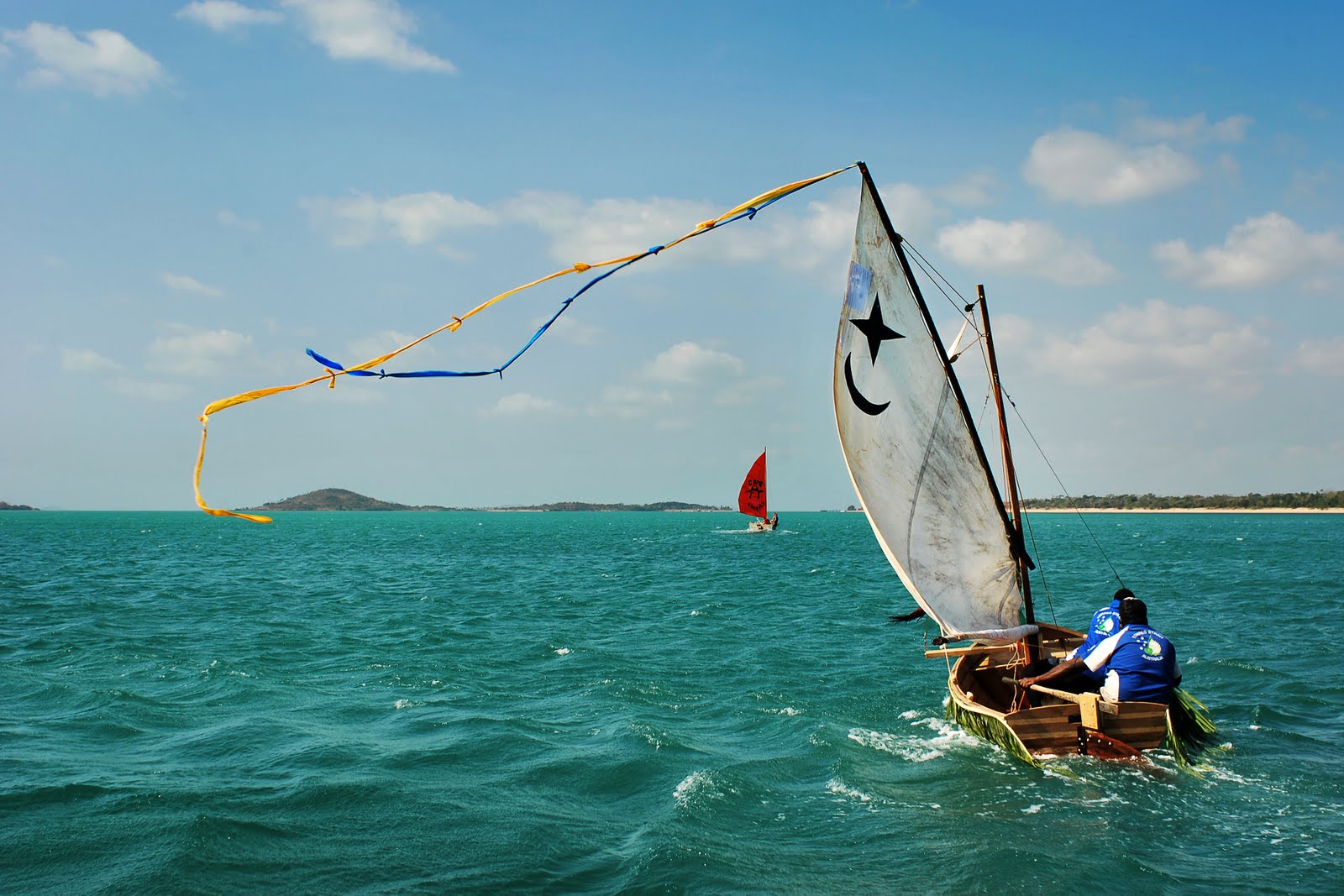
Sunday, January 08, 2012

GOD SAVE THE QUEEN


That was Eddie's place there, she says, pointing to small hollow set back from the beach. It is overgrown with bamboo, and at this hour of the morning is sitting in the shade of a hill rising steeply behind it. Vines run across the yellow sand and down to the beach like cargo cultists. All around, the beach is littered with round, black, basaltic rocks, a kind of volcanic bowling alley. Some have been gathered together into a circle, a rough wire grate above them, cold black ash below, and are surrounded with translucent yellow shapes of turtle shell.

He had a shack there, but it's gone now. Come on kids, you got school.
The boy gets up from where he is playing with a broken life ring, and goes into the corrugated tin shack with his older sister. Their father stands, baby in his arms, looking out to sea.

We moved back up here from Townsville a few years ago, she says. We like it here.
I look around at the large drift logs. Pine pallets embedded upright in the sand. The galvanised iron shack surrounded by fishing nets, lines, lures.

This is our home, she says. She pauses as the kids come out from the shack carrying their school satchels.
Eddie came back too, she says. They dug him up, where he was buried in Townsville, and brought him back here. His tombstone is up there, on top of the hill. This was Uncle Koiki's home. He's very famous here, you know.

It shouldn't surprise me that Eddie Mabo's place on the beach is so humble. The native title case was never about the acquisition of property. At least not from Mabo's point of view. During the High Court case in '92, other Islanders tried to argue the point on who owned what, which piece of land belonged to whom, and challenged Mabo over his land claim. Which only served to bolster his case against the crown. His point was that a system of land ownership existed long before the arrival of the markay, or white man, in Australia. During the final hearings, no-one could argue that the Meriam people did not cultivate the soil, for as Justice Brennan noted, they were devoted gardeners. And it would be hard to argue that the Murray Islanders' relationship to their lands was not proprietary. The evidence showed they owned land as individuals and as families, and had clearly demarcated property boundaries.

She points out the fish traps. Out from the shacks, cutting a swathe through the warm sea, black basalt rocks laid in a long serpentine line.

Those fish traps, they been there a long time, she says. Uncle Koiki showed the justices when they came up here. They looked here, and they looked there – but those? Very important, those stones. They took pictures of my son out there.
Who?
That film crew, they were here a few weeks ago. My son was in it, they filmed him. My daughter, too. My son played Eddie Mabo when he was younger, catching fish out there on those rocks. My daughter played his girlfriend, back when he was younger.

Dang. Missed a scoop there. All I got out of the young kid was a massive fart and some giggles, while the daughter said nothing at all. Ah well, how was I supposed to know they were film stars.

The major victory in the Mabo case was when the High Court agreed that the Common Law of Australia, properly considered, provides for the recognition and protection for the pre-existing land rights of the Indigenous peoples. For Uncle Koiki, this was more important than staking out a piece of real estate on the beach.

And while little remains of Uncle Koiki's place of residence, the principles that guided him - Malo law - remain strong. Tag mauke mauke. Teter mauke mauke. Don't touch or take what isn't yours. Don't set foot on land that isn't yours. Murray Island is no place to be wandering around, markay or not. You don't just head down to the beach for a swim or a spot of fishing and splash about with your floaties doing whatever you want. All parts of these waters belong to someone - a clan, a family - and have for a long time. The locals draw their identity from it. For Torres Strait Islanders, this is not a history lesson, or some abstract concept. This is life.

You see it in the daily ebb and flow of the Torres Strait, the Islanders and their homelands in a symbiosis as natural as drawing air. Islanders not only take their food from the land and sea around them, but their totem animals as well. The deumer, or Torres Strait Pigeon, the beizam, or hammerhead shark, the koedal, or crocodile, and other animals adorn elaborate tombstones laid out across these islands, tombstones that may often stand in a family's front yard. Fishermen and cray divers will talk about this or that patch of reef like I might talk about a vege patch in my back yard.

Commercial cray divers fishing the reefs of the Torres Strait have, in the recent past, had their catch seized and been driven off by the point of a spear or the blade of a machete. Benjamin Ali Nona's infamous incident with the spear occurred at the end of the last millenium, after which Mr Nona took the name Maluwap, meaning 'sea spear'. More recently, a cray diver was (allegedly) pulled up by his air hose and smacked about the head with a machete on Number One Reef north of Keriri, or Hammond Island. I say 'allegedly' because that case is still before the courts. Maluwap won a significant victory when he was acquitted of the charges he faced – charges that were the equivalent of armed robbery – on the grounds that he was simply taking back what he justifiably believed to be his property.

Former Indigenous federal senator Aden Ridgway noted similar incidents of commercial fishermen breaching a 'gentlemen's agreement' to refrain from taking catch within a 10-mile zone of each island had gone unchecked by the government authorities who were supposed to enforce the Torres Strait Treaty, a law legislated to protect the fishing rights and way of life of the Islanders.

"… the real victims of the law were the Islanders and the commercial fishermen, one because they held a real expectation that government would honour the treaty, and the others because of the failings of government to enforce the meaning of the treaty so that they understood what they could do," Ridgway said in his maiden speech to parliament in 1999.

In July, 2010, Maluwap Nona won a landmark native title sea rights case for Torres Strait Islanders as a whole. But our Australian government is currently appealing the decision. Send her victorious, happy and glorious, long to reign over us, et cetera. With his solid build and dreadlocks, Maluwap drops into the offices of the paper from time to time. When he has something to say, I tend to pay attention.

But the long and short of it, in a practical sense, is that you don't go traipsing about willy nilly across these islands. Especially on Mer. Here, you don't even go in to someone's yard to knock on their door. You stand on the edge of the property, call out, and wait.

I sit on a sunbleached log and gaze down the beach. The film crew who were out here a few weeks back were producing a movie simply called Mabo. They were chased off the island. I heard rumours they were woken in the early hours by a wild man wielding a machete, but the Thursday Island police played down that version, saying it was more likely a length of pipe. In the morning, the Mer community convinced the nervous ABC crew to stay on, but after their vehicle sustained what the senior sergeant described as 'wilful damage', they upped sticks and left.

Of course I ran the story on the front page. And of course the Mer community wanted to talk to me about that. It was blown out of proportion, they said. We are not violent people, they said. Come visit us, they said. So I did.

Only a couple of generations ago, Murray Islanders were headhunters. I was advised that I would be sleeping on a verandah next to the 'grandfather drum', or Malo drum. And to be very careful of how I treated it. Because the grandfather drum has 23 notches. Each notch represents the head of a victim who walked on the wrong side of the Malo drum, who disrespected it by walking behind it. 23 is a nice number, I said. A magic number. And I have no intention of changing it to 24. The other half of this pigeon pair, the grandmother drum, was commandeered by a visiting ship some centuries ago, around the time Fernando Torres navigated these treacherous straits.

As it transpired, my hosts could not have been more hospitable, inviting me to join a charter flight with a few others – Ed from Health, Michelle from Indigenous TV, and Nancy from local radio – to fly up and cover a weekend of dancing and festivities. They were just digging up the kup muri turtle when we arrived, right on sunset, and it was quite something to watch bronze whaler sharks thrashing about on the shoreline in a fight for the scraps. Didn't stop Ed and I taking a quick dip the next morning. It is shark mating season, and i figured the bronze whalers would be too preoccupied to bother with a couple of crazy white markay. We could see them, going hard at it just a couple of metres from the coconut palms lining the beach. But it didn't seem right to stare.

The kids come out of the shack with their school satchels, and head off up the steep embankment, through the undergrowth. The sun is well and truly up now and the sweat trickles down my front like the first drips of an espresso. Which reminds me. I need a coffee. Four hours sleep last night, two the night before. Usually I sleep half the day after deadline, but I wasn't going to miss Mer. Not for squids. I look down the beach. The indigenous TV presenter is getting some shots, pictures of our Islander guide talking to the turtle tracks that sweep the beach everywhere here. It's laying season, and they're on the move. We don't have to hunt them, our guide says, they just come right up on the beach for us. If you see one set of tracks going in to the bush, and no tracks coming out, you know she's still in there. You just go pick her up.

I'd heard eating turtle is like chewing on wetsuit, but the kup muri feast they served up last night before the dancing was tender, spicy and delicious. Praise be to God. And the eggs made a really nice breakfast. Needless to say, I didn't get up in the middle of the night to wander around looking for the toilet. 23 notches is fine. It's a nice number.

I catch up with Ed and the TV presenter, and we wind our way up through the jungle, on the heels of our guide.

Eddie Mabo's place back there, I say to Michelle, as she lunks her tripod and camera up the clay track.
What? Where?
Back there.

We trudge on. It's hellish hot and humid, and now there are sharp stones on the track. I've left my thongs way back on the beach. I thought we'd gotten up at 5.30 to go watch turtles laying eggs. Nobody said anything about a jungle trek. My feet aren't made for this. I'm not sure what they were made for, but it certainly wasn't walking. We reach Uncle Koiki's headstone. It is more impressive than his beach home. We sit amongst the banana grove as the stringy wisps of the kapok tree stream down around us in the hot, still air.

Tuesday, December 27, 2011

DO THEY BITE

I'm balls-deep in water trying to get phone coverage. This would not normally be a problem, but there is a big crocodile living just over there at Red Island. And he visits the beach regularly. I ran into Danny last night at the fishing club after the raft race. Danny is the manager of the holiday park where I'm camped.

Got a call saying the croc was up on the beach, he says. Someone left a crab pot there.
So how do you shoo away a four-metre saltwater crocodile? i ask.
He stares at me in disbelief.
You don't. You shoo away the campers.

I keep my phone call short and my eyes on the water. I had a tourist ask about crocs on Thursday.
Do they bite? she asked.

I walk up the beach and drop my shirt and phone and go back in the water for a quick dip. I squat down and splash some water on my face. All the while I'm peeling eyes like a kitchenhand in a cannibal restaurant. Then it's back up the beach, grab the shirt, and back to the tent. No point using a towel. I'll be dripping in sweat again in no time anyway. I use the tap to rinse the sand off my feet and let the salt dry on my skin.

It's hot. I lie down in the tent for a brief relapse. After the madness of the raft race, it is a great relief to just stretch out in this tropical heat and do nothing.

THE PENINSULA PIRATES REGATTA

It's a pretty boat, but small, almost toy-like. A large islander walks down through the coconut grove and picks up the line from the stingray anchor. He starts to haul it to shore. The rest of his group sit on the sand around the ashes of last night's fire. I walk down and join him on the shoreline.

Boat blo yupla? i ask.
Wa.

The small craft crunches up onto the sand. I see the mast is a length of three-by-two pine. The boom is the same, and a roughly-sawn piece of ply is lying in the bottom of the boat. It's a centreboard. Another length of construction pine runs cross-wise to strengthen the mast. The tiller is a length of hardwood attached with galvanised screws to the plywood rudder. Most of the fittings are handmade. The pulleys and eyelets for the ropes are all hand-carved from blocks of pine, as are the cleats on the gunwales.

You build this boat? i ask.
Wa, I mekem, he says.
Looks like its from the 50s.
Dis dinghy, i get im down south, dempla bin call im a 'clinker'.
Because of the way those boards overlap?
Wa. I mekem mast and sail, tiller, mekem sailbot.
He points to the centreboard, which still bears the markings of a felt-tip pen.
I suddenly realise this vessel has been built with a specific purpose in mind.
You're going in the raft race?
Wa.
So this is an entry in the Peninsula Pirates Regatta, an annual raft race from Umagico to the fishing club at Seisia. Well, 'annual' in the sense that it was held for the first time around this time last year, give or take a tide or two.

I've been camped at Seisia for a couple of days now, having come over to the mainland from Thursday Island to cover the race for the paper. Having not seen any of the rafts, this year or last, I was not sure what to expect. In all honesty, I was expecting to see a bunch of empty cans of XXXX Gold tied together with driftnets. Or perhaps a beer-keg outrigger with a beach umbrella for a sail. Or bamboo. Lashings of bamboo. I didn't realise you could use an actual, prefabricated boat as the basis for your 'raft'. I'll be having a word with the scrutineers. What kind of show are they running here?


Friday, August 19, 2011

COCONUTS KILL MORE PEOPLE THAN SHARKS

A good day for journalist is a bad day for someone else. Today was a bad day for a journalist.
Today i got news that three of ABC's finest were killed in a helicopter crash at Lake Eyre in central Australia. And news that an editor-in-chief i worked with in Phnom Penh is currently hunkered down in Kabul, Afghanistan, after an attack on the British Council. "It always looks worse from the outside." And in Misratah, our former editor of photography narrowly escaped with her life by untying her constraining ropes and jumping from one balcony to another after Libyan thugs took her hostage. "It's amazing the pretty colors a rifle butt, a fist, an army boot, and having your head smashed repeatedly into a concrete floor can produce. No camera left to take a proper picture though." But the cameraphone picture was horrifying enough.

Meanwhile, here in the Torres Strait, the tide came in this morning, and went out this afternoon. The only clear and present danger on Thursday Island is spraining a wrist falling out of a hammock, or being hit by a falling coconut whilst sipping a piña colada.

Of course coconuts kill more people than sharks. Sharks aren't stupid enough to sit under coconut trees.


Monday, August 01, 2011

MUSHROOMS IN THE LOUNGE

Sure, it wasn’t a mind-blowing idea for our first magazine cover, but then again, the hallucinogens weren’t that mind-blowing, either. But the mushrooms were certainly easy to come by, especially with a supplements editor wandering the office throwing bags to all and sundry. Now that's what i call "supplements". Not that the distribution of hallucinogenic mushrooms to news staff happened every day. Not at all. This was only usual on Thursdays. As a Monday to Friday daily, our partying schedule started on Thursday nights with beers at Cantina, and continued until around Wednesday the following week.

The mushrooms smelled like the nether regions of a Ukranian prostitute, only cheaper. And slightly more uplifting, leaving us in fits of laughter all night long. But you never can tell with mushrooms. I believe it was the systematic abuse of mushrooms that led our business writer to believe that it was a good idea to fly to Tehran, be beaten senseless by Iranian government forces for violating curfew during an election, and file copy about it. But each to their own. I was more focused on aesthetics. And it was while swimming in the pool at Fly Lounge on the funny black mushrooms that i came up with the idea for the magazine cover. With its glass walls, it was a simple matter for us to photograph each other floating in this tepid water, like creatures in Damien Hirst formaldehyde, before flopping down amongst the throw cushions in the lounge to drink mojitos and giggle hysterically.

After discovering this small human aquarium tucked away in a tiny but classy shopfront cocktail bar, i realised we could use it to produce some amazing underwater images. Because of its glass wall, no underwater camera was needed. All we needed was a beautiful young Khmer model, two studio flashes set up over the pool, and a photographer. Easy peasy. Plus a range of dresses that would float delicately underwater around the model. That was the idea, anyway, and that was to be the cover image for the first edition of our new lifestyle magazine, 28Days. A dreamlike underwater image of a model, with a pointer to a lively, well-written, informative feature on swimming pools in the Cambodian capital. Swimming pools in hotels, resorts, bars, and sports centres. The model on the cover would appear elegant, with delicate fabrics floating serenely around her. The image and story feature would combine fashion, sports, luxury accommodation, sensuality, and drinking, all in one fell swoop. Now that's what i call lifestyle.

Unfortunately, what actually transpired, after the hallucinogens wore off, was a shoot with a model who was terrified of water. Completely and utterly terrified. Not only was Molyvorn unable to swim, but she was seemingly unable to grasp the concept of holding her breath while her head was underwater. The water in the pool only came up to her waist, so all she really had to do was wade in, face the camera, bend her knees and go under. I had been so concerned with finding studio lighting and a cameraman that it never occurred to me this might be a problem. But here was Molyvorn, coming up, after a brief, submerged second or two, on the verge of tears, spluttering and gasping for air. She may well have been in tears: it was impossible to tell. Despite desperate mediations via a series of interpreters, soothing words, visual demonstrations and remonstrations, all our photographer was capturing was a series of images seemingly hell-bent on accurately recreating the terror of the waterboarding torture methods of the Khmer Rouge, only in evening dress.

Eventually our ever-patient and professional photographer, Vinh, managed to snag an image that recreated, to a degree, the dreamlike look i had envisaged, and we all went home.

However our valiant efforts to procure a cover image mattered little when our permanently deranged and sweat-laden Australian publisher, Neal, arrived later that week. Storming into the eighth floor boardroom fresh from the heart of the golden triangle, he was possessed by the redundant and impoverished idea that the first edition of our magazine should not pull focus on the subtle luxuries of the expatriate lifestyle, but, rather, regurgitate, like a whiskey drunk kneeling in a gutter lit by the garish rays of the morning sun, an outrageously melodramatic tabloid rendering of sex, drugs and rock and roll in Phnom Penh.

Sweating profusely, Neal began his manic spiel by pulling from his black leather briefcase an A3 sheet of paper and waving it about like a long-lost Biblical parchment. “Sex and drugs!” he shouted. As he held forth the illustration in triumph, an audible groan came from the editorial staff. The drawing, which looked like it had been knocked out in an aeroplane toilet, featured a rough sketch of a busty brunette holding a martini glass, under the heading "Sex, drugs, and rock'n'roll in the Pearl of Asia". And there, on the bottom, right-hand corner of the page, was a pile of what could only have been methamphetamine. A destructive quantity it was, too. As a design element, it formed a visual coda to a bacchanalian list of editorial contents. The 28Days magazine had rapidly degenerated into The 120 Days of Sodom, and the swirling underwater fashion photos were sunk.

Ultimately, and despite our best efforts to give the sordid theme a sophisticated sheen, this is what our front cover was to look like: a Phnom Penh bar girl seducing the dear reader with a counterfeit come-hither look over a martini glass filled with red cordial. Fortunately, after Neal's departure for Burma, the magazine improved. He hired an actual designer to work on the desk, thereby replacing the mediocre efforts of a clusterfuck of subeditors armed with varying degrees of InEptitude. But thosee first few issues were mangy dogs. And none more so than that bitch of a first issue.


As our sex columnist later said: You can't polish a turd. You can only sprinkle it with glitter. I hired our sex columnist, Lulu, on a whim, after seeing her in a bikini at a beach resort in Kampot. At the time it seemed a reasonable editorial decision. Her writing style was witty and erudite, had a deft knack of avoiding the sordid, and gave the magazine the kind of local spin and spark that we weren't quite getting from The Guardian's Charlie Brooker, with his Anglocentric, politicosurrealist rants and raves.

Before long, however, Lulu was failing to make deadlines, and my editor was demanding i ditch her and hire Ingrid, who was filing for a men's magazine in the Netherlands. I'd read Ingrid's stuff and didn't much like it. Her style was all sex on the washing machine and blowjobs. It was too "in your face" and would probably get us shut down. When i arrived as production editor, Neal had explained to me the three basic tenets of fulfilling the Ministry of Information requirements for publication:

  • All articles must be truthful
  • Articles must not criticise the royal family, either implicitly or explicitly
  • Publications must not contain graphic depictions or descriptions of sex.

But Ingrid’s columns clearly, freely and wantonly flouted at least one of these guidelines. And what if King Sihanouk was one to day read about his fictional consummation of the Queen on a washing machine on the spin cycle? I'm sure he wouldn't take that lying down. But meanwhile, Lulu was running out of topics. What can I write about this week? she wrote in a desperate plea for inspiration. Any ideas? I mulled this over and fired back an editorial missive: I want sex in the workplace, and I want it on my desk at nine o'clock in the morning.

You could write emails like that, back then.

Then, suddenly, prior to his abrupt departure to pursue a career in heroin, my editor-at-large had what he described as a brainwave, and what I secretly diagnosed as an embolism. He decided to hire both sex columnists, and pay our paltry freelance rates to whoever filed copy first. The effect was disastrous. Ingrid and Lulu knew each other, and neither was going to stand for the other pushing in on what each regarded as their territory. Having weaved his magic, the editor-at-large then vanished to the opium dens of Bangkok, leaving me to sort out what, after a few deafening phone calls, was already shaping up as a vicious catfight in the dog-eat-dog food world of magazine publishing.

What can one do? In an attempt to pour oil on the waters, i wrote an email to both columnists: There is only one way to settle this, and that is in an inflatable pool filled with jelly.

You could write emails like that, back then.

PHOTO: VINH DAO

Sunday, July 10, 2011

ЗАМЕСИТИ И МАЗАТИ МАРГАРИНОМ

Saint Mark's Church in Belgrade is, fittingly, a popular and incredibly beautiful church. The dome forms a heavenly canopy far overhead. On the earthly plane, the framed pictures of saints are covered with the lipsticked imprints of kisses. A sweet smell of incense permeates the cool interior.

My travelling companion, Mili X, hands me a candle. You can light candles for the living, and you can light candles for the dead, she says. It would seem, then, wholly inappropriate to light a candle for my son, because, as a teenage Zombie, he falls into neither category. So i genuflect before the ikons, kneel on this ancient stone, and light a candle for his dear departed mother. I close my eyes and pray before its flickering light. I pray she has found peace. I pray she has gone to a better place. I pray someday i may get my record collection back. I then light a candle for my son. Can't do any harm. Pascal's wager, and all that. Then, having fulfilled our religious observances for the next six decades, Mili and i rise and make our way back out of Saint Mark's. I make the sign of the cross (spectacles, testicles, wallet and watch) and we wander back to the Hotel Splendid via the back alleyways and rooftops of Belgrade.

Daylight. I pull the heavy curtains of our Splendid Hotel room aside, and gaze out across the rooftops of the houses of the Serbian parliament. Down on the street below, men with jackhammers are busily undermining the foundations of democracy. There will be no sleeping in today. I pour a few fingers of rum, polishing the nails with strawberry juice. I must brace myself for today's search for black-and-white film.

Out in the plaza, i find it is far easier to order ПОГАЧА and sit eating it with coffee than it is to find a shop that stocks rolls of film. Nobody wants old stuff like film here. Old stuff is communist stuff. Free enterprise is digital. After eating the cheesy corn bread, i wander the plaza regardless, waylaying bystanders with my retro Nikon (no, it's not a Kiev, Zenit or Lomo) in an attempt to find someone with a smattering of English who can point me in the direction of a film vendor. Eventually, a derelict wino borrows my pen, sketches out a map, and asks me for a cigarette. The map directs me to the sixth floor of a nearby office block.

The elevator is one of those contraptions where you need to be sure to keep your appendages completely to yourself. Although i suppose this is proper etiquette whilst inside any elevator. I open its double concertina doors onto a sixth-floor corridor. Part way along, a timber veneered door hangs open, beckoning film wasters with its single, lopsided, faded orange sign: "Agfa". Inside is a man in a leather jacket, black polo neck shirt, and black beret, smoking. He is sporting a black goatee, and has a surreptitious air about him. Clearly, the man is a Satanist.

Given Mili X and i are leaving the capital tomorrow, this is my last chance to stock up on the precious silver, even if i have to deal with the devil. I spy a few black and yellow boxes marked 'Ilford Pan 100'.

Pan 100? I've only ever seen this in 50, i say. Is this some kind of cheap Russian substitute? He shrugs, takes out a few rolls of the film, and places them on the grubby glass counter. He buts out his cigarette in a filter mountain and immediately lights another. He points at my Nikon and beckons. I hand it to him. He handles the rewind spool expertly, and, determining there is no film in the camera, pops the back open and quickly checks its shutter speeds and auto function. He nods. Dobro, he says. He snaps shut the back, points to the film identifier, where i shoved a tag off my last roll of Fuji Neopan. Pointing next at the Ilford 100, he gives the thumbs up, indicating that this film manufactured in some backstreet Gulag will stack up well against the fine-grained, dependable Japanese version. As it transpires, this is complete bullshit. Nonetheless i fork out a pile of dinars for half a dozen rolls, and in appreciation, the Satanist reaches under the counter and comes up with a roll marked with the unlikely name 'Gekko'. With a wave of his cigarette, he indicates this is a freebie. Back on the street, i load a roll and start shooting street scenes. Street scenes. I love street scenes.

When i first arrived in Belgrade, that is, when the JAT aeroplane landed at airport, the passengers broke into loud and heartfelt applause. I found this unnerving. I tend to take an airline pilot's ability to land a passenger jet aircraft somewhat for granted. I don't see it as something to be celebrated with astonishment, gratitude, and a standing encore. Especially when the seat belt sign is still on. But, here we are. Belgrade, however, is only a transit point. For we are on our way to that Hawaii of Eastern Europe, Montenegro. That, at least, is how it is advertised on the billboards. I'm looking forward to the pineapples. Pineapples. I love pineapples.

Twenty minutes past midnight, Sunday morning, and i am on a train to Montenegro, having missed the bus in the scrambled mess that passes for a bus station in Belgrade: a giant clusterfuck of cars, buses and people, all tooting, shouting, and blowing smoke. A bus full of passengers about to set off to a destination somewhere elsewhere in the Balkans is stationary, blasting its horn incessantly at an unmanned car blocking its path. Someone has simply parked a red Yugo right across the middle of the road and left it there, regardless of the available parking spaces dotted around it. Finally, the vehicle is lifted and manhandled out of the way by half a dozen burly Slavs.

After the bus trundles off, the inconsiderate Yugo driver appears, and nonchalantly parks his car in a marked bay. Mili X glares at him, calling him an idiotski under her breath as he stands idly chatting with waiting passengers. He then takes a big glob of gum out of his mouth and drops it on the ground in front of him. I've always wondered, while trying to pick gum off the soles of my Blundstones, what kind of idiotskis do that. Now i know.

When the late-running bus to Montenegro finally arrives, we discover it is not our bus. Our bus left an hour previously from a similarly named street just around the corner. So we hurry and harry a taxi driver across town to the train station, and squeeze onto the last train to Montenegro, and spend three and a half hours standing in a narrow corridor as it groans and wheezes. The ramshackle train does most of the groaning while chain-smokers do the rest. Eventually we bribe a train conductor and he finds us some seats. We fold them down and chase the elusive gremlin of sleep. The two female anglo backpackers beside us manage to somnambulate throughout the entire trip, including the breath-taking scenery, leading Mili X to believe they are in possession of powerful sleeping tablets. They looked and smelled to me like they hadn't had a decent night's sleep or a decent bath since departing the white cliffs of Dover. I down a few shots of rum and fall into a fitful sleep, dreaming of pineapples and Serbian women. I fucking love Serbian women.

The morning sun is bright, accentuating the contrast between this dry, mountainous green landscape and the sudden black tunnels from which it can take several minutes to emerge. Every now and then, when we burst into the blinding sun, i notice some of these chainsmoking people are staring at me. However, i resist the impulse to smile back at them in what might be construed as a friendly manner, as Serbs have a saying in common with the Russians: "He who smiles for no reason must be fucking crazy or stupid or both" and since i had no desire to appear any more idiotic that would came naturally on any given day, i adopt the same blank-to-grim-faced expression as everyone else on the train. Perhaps it's the hair. Before i left Belgrade i dyed my hair the kind of colour you would get if you poured gasoline on a case of tangerines and threw in a match.

A river meanders alongside as, and i watch as it rushes hurriedly over shallow stones, past a couple of fisherman, before winding on past a variety of half-finished houses with steeply-pitched roofs and market gardens and into the occasional town in which the houses stand in jumbled rows, one on top of the other, and disappear beyond the view from the train window as they ramble up the side of a black mountain.

We reach the old Austro-Hungarian fort town of Budva, Montenegro, after a horrifying taxi ride from Bar with a driver from the Evel Knievel School of Taxi Instruction. For this driver, the best possible place for a taxi, if not actually in mid-air flying off the edge of a cliff, is at high speed on the wrong side of a winding, narrow, mountainous road. As we cross a narrow bridge over a ravine, i see where the metal railing has been forced back in a gaping hole. Quaint plastic posies and a delightful Orthodox cross lay next to it. This spectacle energises our taxi driver, who begins tailgating a black, late-model Mercedes Benz with dark, tinted windows, Albanian plates and three antennae - id est, quite obviously a carload of gangsters - before overtaking them with his horn blaring and speeding on through completely unlit tunnels towards oncoming traffic with his headlights off. After communing at length with Jesus, for the most part silently, we arrive in Budva in the unfortunate position of having only dinars and dollars in a province powered by euros on a Sunday morning with fifty kilograms of luggage and nowhere to stay after an allnighter on a train from hell.

We buy two bottles of water and struggle up the hill to look for a room, and very difficult it is, too, carrying bottles which, as you can see from the label, contain over a hundred litres and are larger than a small child. We find a room run by an old lady who is very nice, although it would also be nice if we had hot water and toilet paper, but one can't expect miracles.